






Automotive & Manufacturing


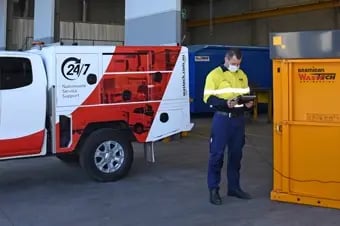



Keeping waste equipment running reliably requires more than calling a technician when something breaks. A preventative maintenance program — scheduled servicing designed to catch developing issues before they become failures — is the structured alternative to reactive repair and one layer of a complete waste equipment servicing and maintenance approach. Covered here: what a Wastech Preventative Maintenance Agreement includes at each visit, how planned servicing compares to reactive repair on cost, and what a maintenance agreement should commit to before signing.
What a Preventative Maintenance Program for Waste Equipment Covers
A preventative maintenance program — sometimes called a planned preventative maintenance program or equipment maintenance program — is a recurring service arrangement where a qualified technician visits your site on a fixed schedule to inspect, test, and service your equipment regardless of whether it is showing visible symptoms.
Across Wastech's full service range — including balers, compactors, chutes, bin lifters, and other waste handling equipment — this means structured attention to mechanical components, hydraulic systems, electrical circuits, and safety interlocks (mechanisms that prevent equipment from operating in unsafe conditions) that would otherwise go unexamined until something fails.
Planned preventative maintenance is different from reactive repair. The difference is timing: a preventative maintenance program is triggered by a schedule, not a breakdown. Reactive repair addresses a problem that has already disrupted operations. Preventative maintenance addresses wear before it gets that far — when intervention is faster and less disruptive.
There is also a regulatory obligation that runs alongside the operational case. Under Australia's Work Health and Safety (WHS) Act, businesses operating plant — which includes balers, compactors, chutes, and other waste equipment — have a legal duty to maintain that plant safely. Safe Work Australia's Managing Risks of Plant in the Workplace Code of Practice (November 2024) identifies plant as a major cause of work-related death and injury in Australian workplaces, and persons conducting a business or undertaking (PCBUs) — any business operating waste equipment — have a duty to maintain that plant safely as far as is reasonably practicable.
SafeWork NSW's 2024–2025 statewide compliance operation, which targets plant safety across manufacturing, retail, and transport settings, confirms that WHS authorities are actively enforcing these obligations. Businesses should verify their specific maintenance obligations with their relevant state or territory WHS regulator, as workplace requirements can vary by jurisdiction and industry setting. A documented maintenance program with a written inspection record at each visit is one of the clearest ways to demonstrate compliance.
Wastech's Preventative Maintenance Agreement — referred to as the Agreement from here — formalises this across all equipment types Wastech services, and positions Agreement customers as Priority 1 for response when unexpected breakdowns occur.
What a Wastech Preventative Maintenance Visit Includes
Understanding the per-visit scope is the starting point for evaluating whether a program makes sense for your operation. Every visit under a Wastech Preventative Maintenance Agreement includes the following:
Site preparation and assessment
- Travel to and from site within metro areas
- Site induction for compliance and safety, up to 15 minutes — first visit only
- Complete risk assessment for equipment and work area
- Removal of loose debris as required (up to 10 minutes)
Equipment inspection
- Operate equipment to test functionality and confirm it is free from unusual noises or actions
- Inspect mechanical components for cracks, corrosion, undue wear, damage, and unsafe conditions
- Inspect electrical components for safe and serviceable condition
- Inspect hydraulic components for leaks, damage, oil level, and condition
Safety compliance checks
- Ensure all safety interlocks are present, clearly labelled, and in good working order
- Confirm all ground anchors are secure and present
Servicing work
- Lubricate all moving points as per the manufacturer's guidelines
- Adjust any minor limit switches as required
- Grease and lubricants, including 1 litre of oil, rags, and consumables
Documentation and close-out
- Full operational test on completion
- Service sticker updated
- Customer sign-off obtained for completed work
- Electronic Service and Compliance report issued for each asset
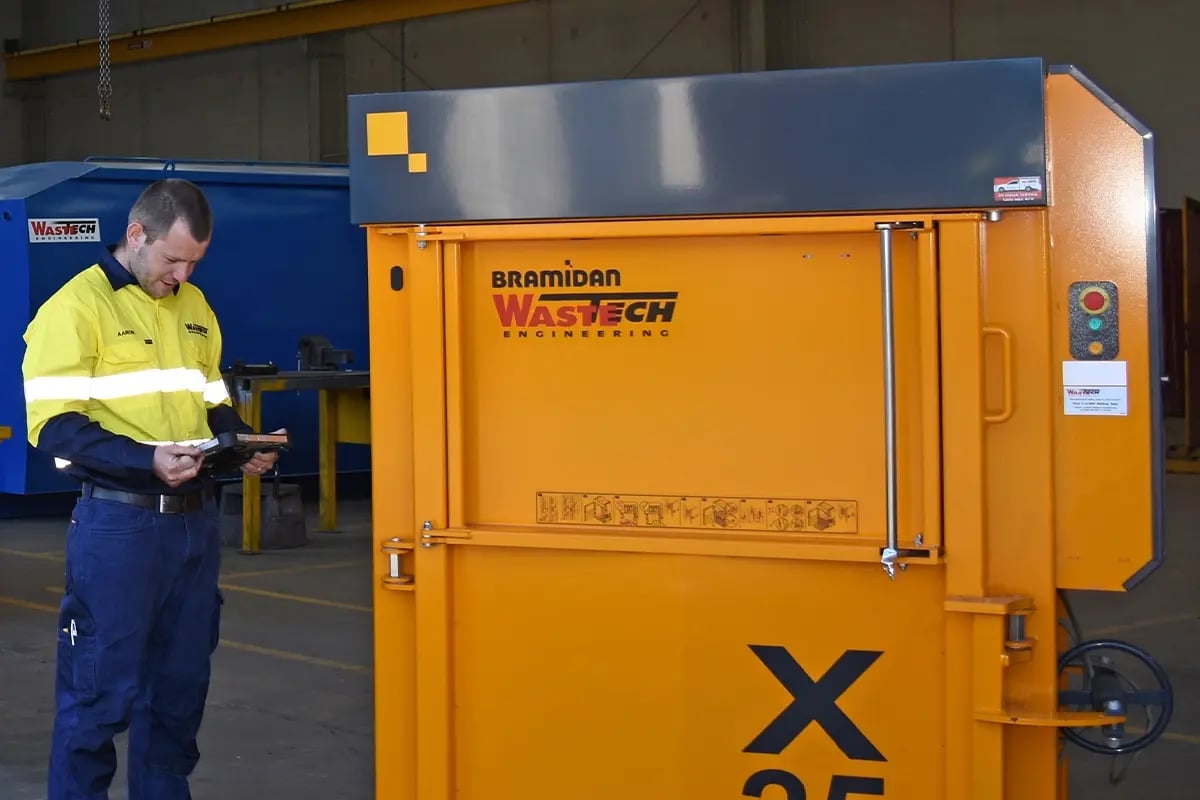
The electronic Service and Compliance report matters beyond operational assurance. For facilities managers and strata operators who need to demonstrate maintenance records for compliance audits, insurance requirements, or internal governance, each visit produces a written and documented outcome — not a verbal confirmation that the work was done. All scheduled servicing is carried out by factory-trained technicians using genuine parts.
Breakdown and repair works are not included under the Preventative Maintenance Agreement. Where a fault is identified during a scheduled visit that requires repair, the work is quoted separately and requires a customer purchase order before work begins.
"One of the most consistent patterns our technicians see during first-time scheduled visits on equipment that has been under reactive maintenance only is safety interlocks that have degraded to the point where they no longer function correctly — not deliberately disabled, but gradually worn without anyone noticing, because no formal check has ever been built into the operation. It is not unusual for operators to be completely unaware this has happened."
— Shael Esler, General Manager, Service Operations, Wastech Engineering
Note that Wastech technicians require clear, safe access to the asset to complete scheduled servicing. Additional costs apply where excessive time is needed to clear debris before the visit can proceed.
How Wastech Sets Your Servicing Frequency
There is no single interval that applies to every piece of equipment. Wastech sets Preventative Maintenance Agreement intervals at 1, 3, 6, or 12 months, determined by three factors.
- Equipment type is the starting point. A hydraulic baler ram accumulates stress through hundreds of compression cycles — the hydraulic seals, baling belt, and platen all wear differently to the blade drive and oil cooling system of a compactor. Servicing cadence reflects those component differences, not a generic schedule applied across all machines.
- Material type has a larger effect than most operators expect. Corrosive or wet material — food waste, chemically active streams, anything with high moisture content — accelerates wear on hydraulic seals, electrical enclosures, and structural components at a rate that dry cardboard or clean plastic simply does not. A baler processing wet food packaging in a hospitality setting typically warrants more frequent servicing than one handling retail cardboard, even if usage volume is similar.
- Volume processed tells you how hard the equipment is actually working. A compactor running multiple cycles daily accumulates operating hours far faster than one used twice a week.
Australian conditions add further considerations. In Wastech's service experience, hydraulic systems operating through Australian summers can run at temperatures that accelerate oil breakdown beyond what standard manufacturer schedules assume — particularly in poorly ventilated plant rooms. In industrial and semi-rural environments, dust accumulation inside electrical enclosures is one of the most commonly underestimated fault contributors, and one of the first things Wastech technicians look for on a scheduled visit.
Wastech's service team works with each customer to set intervals that reflect actual operating conditions rather than defaulting to an annual visit that may leave higher-use equipment under-serviced.
Preventative Maintenance vs Reactive Repair: What the Evidence Shows
The financial case for planned maintenance is well-documented. ABB's 2023 Value of Reliability survey — commissioned research by Sapio Research across 3,215 plant maintenance decision-makers, including Australian respondents — found that 69% of Australian industrial businesses experience unplanned outages at least once a month, and that unplanned downtime costs the typical Australian industrial business approximately $349,000 AUD per hour. These figures cover industrial operations broadly and are not specific to waste equipment.
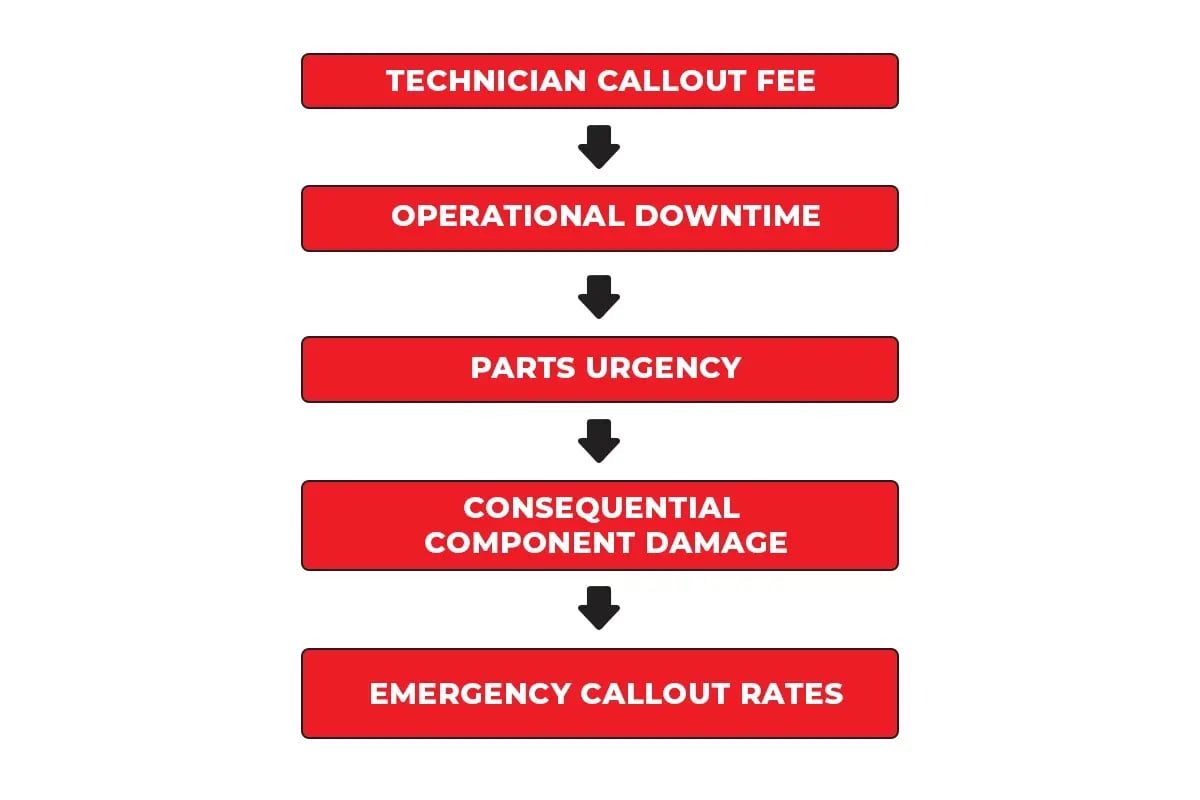
According to the US Department of Energy's Federal Energy Management Program, implementing preventative maintenance programs saves 12–18% on maintenance costs compared to reactive approaches, and emergency repairs typically cost 3–5 times more when indirect costs — downtime, consequential damage, and parts urgency — are included. This is US government research conducted in an energy management context; the directional relationship between planned and reactive maintenance costs is supported by industrial maintenance research across sectors globally.
| Factor | Preventative Maintenance Agreement | Reactive Repair |
|---|---|---|
| When it applies | Scheduled visits at agreed intervals — 1, 3, 6, or 12 months — set at the start of the agreement | Triggered by a fault or breakdown after it has already disrupted operations |
| Cost profile | Predictable, planned expenditure per visit | Variable; emergency callout rates and parts urgency typically apply |
| Cost predictability | Service fees locked in for 24 months — costs known and budgetable from the start of the agreement | Unpredictable; emergency callout rates, parts costs, and downtime costs are all variable and unplanned |
| Parts and consumables | Consumables included per visit; replacement parts identified and sourced in advance where possible | Emergency sourcing required; downtime extends if parts are not held locally |
| Operational downtime | Minimal; visits scheduled around your operating hours by agreement | Unplanned; duration depends on fault severity, technician availability, and part lead time |
| Consequential damage risk | Lower; faults caught before failure reduce the risk of secondary component damage | Higher; components failing under load can damage adjacent parts, compounding repair cost |
| Documentation | Electronic Service and Compliance report issued for each asset after every visit | Variable; may not produce a formal written record suitable for audit or insurance |
| Breakdown response (Wastech) | Priority 1 — targeted attendance within 4 hours for site operation breakdowns | Standard service queue; response time not guaranteed |
| WHS compliance evidence | Written inspection record at every visit supports compliance with PCBU maintenance obligations | Ad hoc records; may not satisfy documentation requirements under the WHS Act |
Beyond the cost structure itself, a Wastech Preventative Maintenance Agreement offers fixed pricing for a 24-month period — service fees are locked in from the start, allowing operations teams to budget accurately rather than absorbing unplanned emergency costs.
"When we attend equipment that has been running on reactive maintenance only, degraded hydraulic oil is one of the most frequent findings — discoloured, contaminated, and well past its service life. The internal wear it has caused to seals, cylinders, and valves by that point is almost always more expensive to address than the cost of scheduled servicing over the same period would have been."
— Shael Esler, General Manager, Service Operations, Wastech Engineering
A preventative maintenance program does not guarantee equipment will never need unscheduled repair. What it does is change the profile of failures — catching wear under controlled conditions, when replacement is a planned task rather than a crisis.
What a Preventative Maintenance Agreement Should Include
A preventative maintenance contract — also referred to as a maintenance service agreement or planned maintenance agreement — formalises the service relationship. Before signing, these elements should be clearly defined in the document:
- Scope of equipment covered: The agreement should list exactly which assets are covered — model number, serial number, and location for each. Vague scope language creates ambiguity when a dispute arises.
- Service frequency and scheduling approach: Agreed intervals for each asset should be stated explicitly, along with how scheduling works in practice: whether visits are coordinated around your operational hours, how much notice is given, and how rescheduling is handled when a planned visit conflicts with a site shutdown.
- Defined scope of work per visit: A clearly written agreement specifies what happens at each visit — inspection items, servicing tasks, and consumables included. Agreements referencing "routine maintenance" without defining scope create disputes and make it impossible to verify whether the service was delivered as agreed.
- Response time commitments in writing: The agreement should state target response times for unscheduled breakdowns. Wastech's commitment for Agreement customers is attendance targeted within 4 hours of receiving a purchase order for site operation breakdowns, and typically within 24 hours for minor repairs. Any service provider offering a maintenance agreement should put response time expectations in writing.
- Documentation and reporting requirements: Each visit should produce a documented outcome that can be provided for audits, for insurance, or for internal records. Wastech's Agreement includes an electronic Service and Compliance report for each asset after every visit.
- Parts and labour terms: Clarify what is included versus what is quoted separately. Wastech's Agreement includes consumables (grease, lubricants, 1 litre of oil per visit). Replacement parts or repairs outside the standard scope are handled and quoted separately. Transparency on this boundary prevents disputes.
- Escalation and approval procedures: The agreement should specify how a fault identified during a scheduled visit is communicated, quoted, and approved before additional work proceeds.
- Scheduling hours and advance notice: Scheduled service work is completed during standard business hours — 7:30 am to 4:00 pm, Monday to Friday — unless otherwise stated in the agreement. Visits are booked well in advance so the schedule is confirmed before it matters.
- Renewal terms: The agreement should state whether it auto-renews and on what terms. Wastech's Agreement auto-renews on its anniversary date unless either party provides notice within the 30-day opt-out window before expiry. New pricing is provided before each renewal.
Priority Response for Preventative Maintenance Agreement Customers
One of the practical benefits of a Wastech Preventative Maintenance Agreement extends beyond the scheduled visits. Agreement customers receive Priority 1 response for unscheduled breakdowns, with Wastech's service team targeting:
- Within 4 hours of receiving a purchase order for site operation breakdowns
- Within 24 hours of receiving a purchase order for minor repairs
- At agreed scheduled intervals (1, 3, 6, or 12 months) for planned servicing
For businesses managing equipment across multiple locations, or in regional areas where technician availability is more constrained, priority access for unscheduled callouts is a real operational advantage. These are attendance targets rather than guarantees — but a targeted 4-hour response versus a next-available slot can determine whether a facility stays operational through a disruption.
Next Step: Set Up a Preventative Maintenance Program
If you are evaluating whether a formal preventative maintenance program makes sense for your equipment — or reviewing what your current service arrangement actually covers — Wastech's service team can assess your equipment, recommend service intervals, and structure an agreement around your operating conditions.
Enquire about a Preventative Maintenance Agreement: wastech.com.au/service-support
Book a technician: wastech.com.au/service-support/book-a-technician

AUTHOR
Hannah Gomez


Hannah Gomez is the Customer Engagement and Service Sales Specialist at Wastech Engineering, supporting customers with tailored Preventative Maintenance Agreements and long-term servicing for their waste-handling equipment. With a strong focus on relationship building, she works with customers to understand their sites, equipment and operational needs, keeping their assets maintained effectively and supported throughout their lifecycle.