

Automotive & Manufacturing


Overview of Baler Machine Types
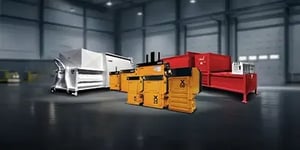
Vertical baler types vary across size, material, and automation level, and matching the right category to your waste volume, space, and handling requirements comes before choosing a specific model. This guide compares Wastech's standard and specialty vertical baler types to help businesses identify the most suitable equipment for their operation. For a complete overview of how balers work, see our guide to what a baler machine is.
Main Types of Baler Machines
Baler selection generally comes down to three factors: waste volume, material type, and the level of operator involvement required. Wastech's range covers four size tiers, plus specialist equipment, from compact balers for lower-volume sites through to extra-large models for high-volume distribution operations.
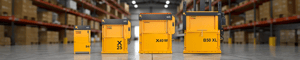
| Size tier | Models | Bale weight (cardboard / plastic) | Press force | Power | Best suited for |
|---|---|---|---|---|---|
| Small | B3, B4, B5W, X10 | 30-110 / 40-130 kg | 3-10 t | Single-phase (X10 also 3-phase) | Retail stores, cafés, schools |
| Medium | B20, X25, X25 Galv, B30, X30 | 200-350 / 250-450 kg | 20-30 t | Three-phase | Supermarkets, warehouses |
| Large | B50, B30W, X50, X50 Galv | 350-500 / 400-600 kg | 30-50 t | Three-phase | Manufacturers, logistics centres |
| Extra Large | B50 XL SD | 650-800 / 650-800 kg | 50 t | Three-phase | High-volume distribution |
| Specialist | Drum Press DP16 | N/A (drums) | 16 t | Three-phase | Steel or oil drum processing |
-
Vertical Balers
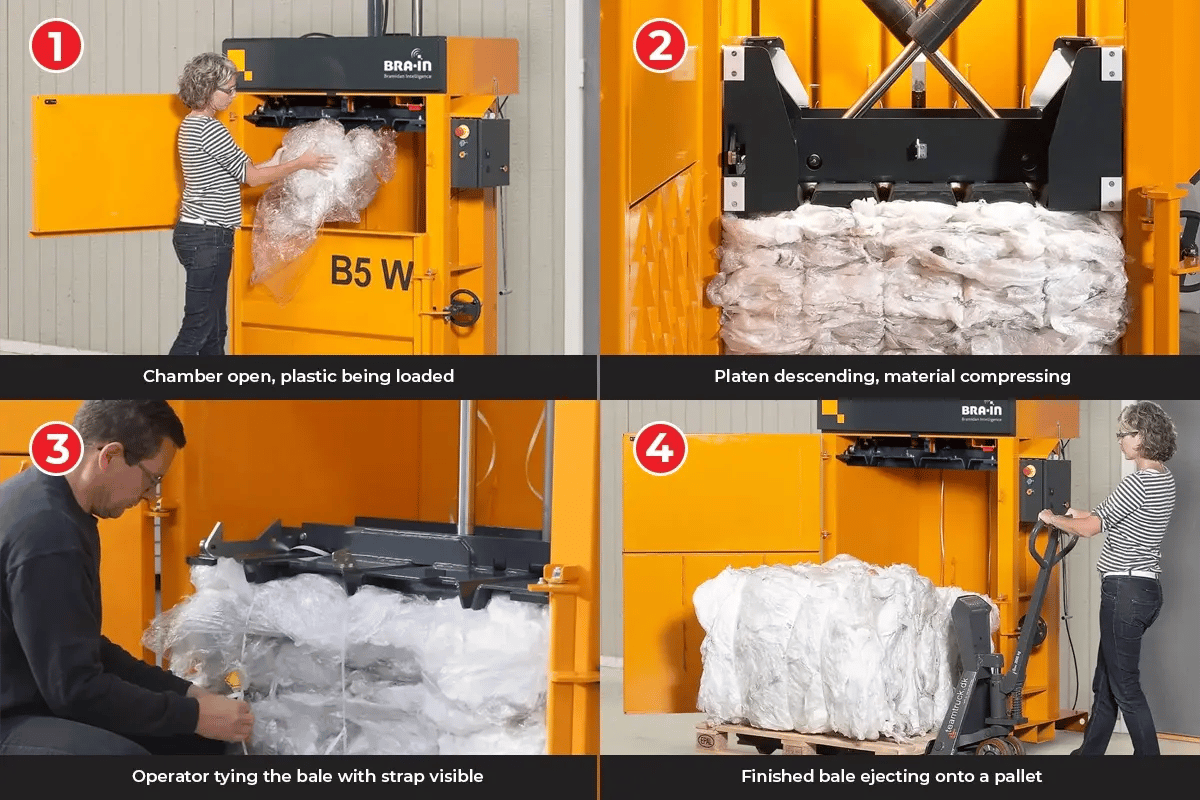
Vertical balers, also called downstroke balers, are the most common baler type in Australian businesses. The press platen moves vertically downward, compressing material into a dense bale. Their compact footprint and front-operated design mean they can often be installed against a wall, making them practical for commercial and industrial sites.
-
Small Vertical Balers
Small vertical balers (B3, B4, B5W, X10) produce cardboard bales from 40-110 kg with press forces from 3-10 tonnes. Most models run on single-phase power, and the X10 is available in both single-phase and three-phase configurations. This makes the smaller models suitable for businesses with lower waste volumes or sites without an existing three-phase supply. The B5W, for example, offers a 1-metre wide filling opening, letting bulky boxes go in without breaking them down first.
-
Medium Vertical Balers
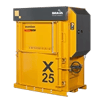
Medium vertical balers (B20, X25, X30, B30) produce cardboard bales from 200-350 kg at 20-30 tonnes of press force. These models require three-phase power and are suited to supermarkets, distribution centres, manufacturing sites, and logistics operations generating steady, moderate waste volumes.
The X30, for example, pairs a wide filling opening with a low overall height, making it useful on sites where ceiling clearance is limited. Browse the full medium vertical baler range for complete specifications.
-
Large Vertical Balers
Large vertical balers (B50, B30W, X50, X50 Galv) handle heavier vertical baling duty, with press forces from 30-50 tonnes and cardboard bales up to 500 kg. These models require three-phase power and suit manufacturing facilities, logistics hubs, and industrial operations processing higher volumes of recyclable material.
The X50, for example, uses a hydraulic system designed for high-capacity operation and long service life, making it suitable for continuous heavy-duty compaction.
-
Extra-Large Vertical Balers
The Baler B50 XL SD is Wastech's extra-large vertical baler, producing 650-800 kg bales using 50 tonnes of press force. It features an extra-wide 1.82-metre sliding door and a 1.1-metre-deep chamber, allowing large quantities of material to be loaded efficiently.
The larger chamber and bale size make the B50 XL SD suitable for high-volume distribution and industrial operations where bale capacity and transport efficiency are important considerations. Its configuration allows bales to stack two per truck row instead of three, improving transport utilisation.
-
Understanding Other Types of Balers
Industrial recycling balers are one category of baling equipment. Other baler types are designed for specific materials and applications.
Agricultural balers compress hay, straw, and crop residue into transportable bundles for farm storage. These machines are designed for agricultural applications rather than commercial recycling.
Tyre balers are designed to compress shredded or whole waste tyres into dense bales for tyre recycling. Rubber behaves differently under compression from cardboard and plastic, so tyre balers use equipment designed specifically for this material.
Scrap metal balers are heavy-duty machines for ferrous and non-ferrous metal scrap. They produce dense bales for smelting or resale and require substantially higher press forces than equipment used for cardboard or plastic.
For Australian businesses managing cardboard, paper, plastic, PET, or similar recyclable materials, vertical recycling balers are the relevant equipment category.
Types of Balers by Material
Beyond size, baler selection also depends on the material stream, since different materials behave differently under compression.
-
Cardboard and OCC Balers
Cardboard and OCC (Old Corrugated Cardboard) balers are the most common configuration, built for corrugated boxes, mixed paper, and packaging board. This is the default use case for most of Wastech's B-series range.
-
Plastic Balers
Plastic balers handle materials such as plastic, shrink wrap, and PET bottles. These materials can spring back after compression more than cardboard, which is why chamber retainer design is an important consideration for plastic-heavy waste streams.
-
Aluminium Can Balers
Aluminium can balers compact used beverage cans into dense, stackable bales. They are commonly used by beverage retailers, hospitality businesses, and recycling collection points.
Wastech's X-series is designed for a broader material range, including PET bottles, aluminium cans, tin cans, hard plastic, textiles, and EPS.
Wastech's B-series vertical balers are optimised for cardboard, plastic, and paper. The X-series is designed for a broader range of recyclable materials, including PET bottles, aluminium cans, tin cans, hard plastic, textile, and EPS, making it the better fit for mixed-material waste streams rather than a single material type.
Material Separation and Bale Quality
Keeping material streams separate when baling can affect the quality and value of the finished bale. Cardboard contaminated with plastic, metal, or other materials may not meet the requirements of some recycling markets.
From 1 July 2026, consignments of regulated waste paper and cardboard exported from Australia must not exceed 5% contamination by weight, under new licensing requirements from Australia's environment department. For businesses supplying recyclable material into downstream recycling markets, keeping material streams clean and separated can therefore be an important part of the baling process.
Baler Types by Automation and Handling
Balers are also grouped by automation level, which affects labour input, cycle consistency, and capital cost.
Manual balers require an operator to load material, initiate the press cycle, and tie the bale by hand. The B3 is the one model in Wastech's range still using fully manual bale ejection.
Semi-automatic balers automate part of the process, typically bale ejection, while still requiring manual tying.
Fully automatic configurations handle continuous feeding, compression, tying, and ejection with minimal operator involvement. These systems are generally suited to high-volume operations where continuous throughput and reduced manual handling are priorities.
Aside from the B3, every model in Wastech's vertical baler range uses automatic bale ejection, reducing operator handling without requiring a fully automated baling system.
-
Bale Tying: Twine vs Steel Wire
Bale tying method is another practical difference between models, not just a size or material question. Polypropylene twine is lighter, more cost-effective, and easier to handle than wire, while steel wire offers higher tensile strength and is suited to larger, heavier bales.
Wastech's B3, B4, B5W, X10, and B20 tie exclusively with twine, while the X25, X25 Galv, B30, X30, B30W, B50, X50, X50 Galv, and B50 XL SD all offer a choice between twine and steel wire, giving businesses handling heavier or bulkier bales the option of a stronger tie without changing machine size.
Specialty Vertical Balers
Some environments and applications call for a configuration beyond the standard size-tier range.
-
Galvanised Balers
Galvanised models (X25 Galv, X50 Galv) are hot-dip galvanised to DS/EN 1461:2009, giving corrosion resistance for environments where moisture exposure is a concern. They are suited to outdoor placement, food processing, or fisheries environments.
-
Wide-Opening Balers
The B30W has a feed opening exceeding 1.5 metres, handling the largest boxes without needing to break them down first.
-
Drum Press DP16
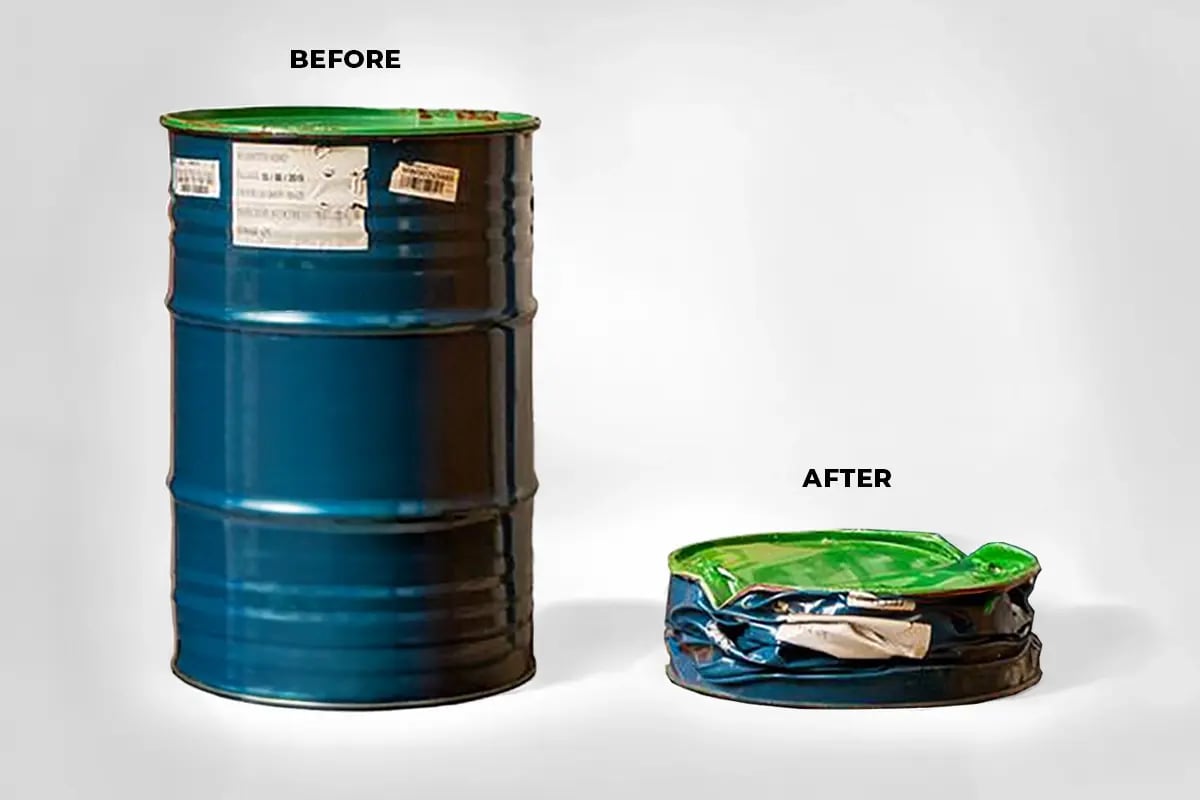
Drum Press DP16 is a dedicated drum compactor, purpose-built to compress steel or oil drums up to 200 litres by up to 90%, using a 16-tonne press force and 45-second cycle time.
How to Choose the Right Baler Type
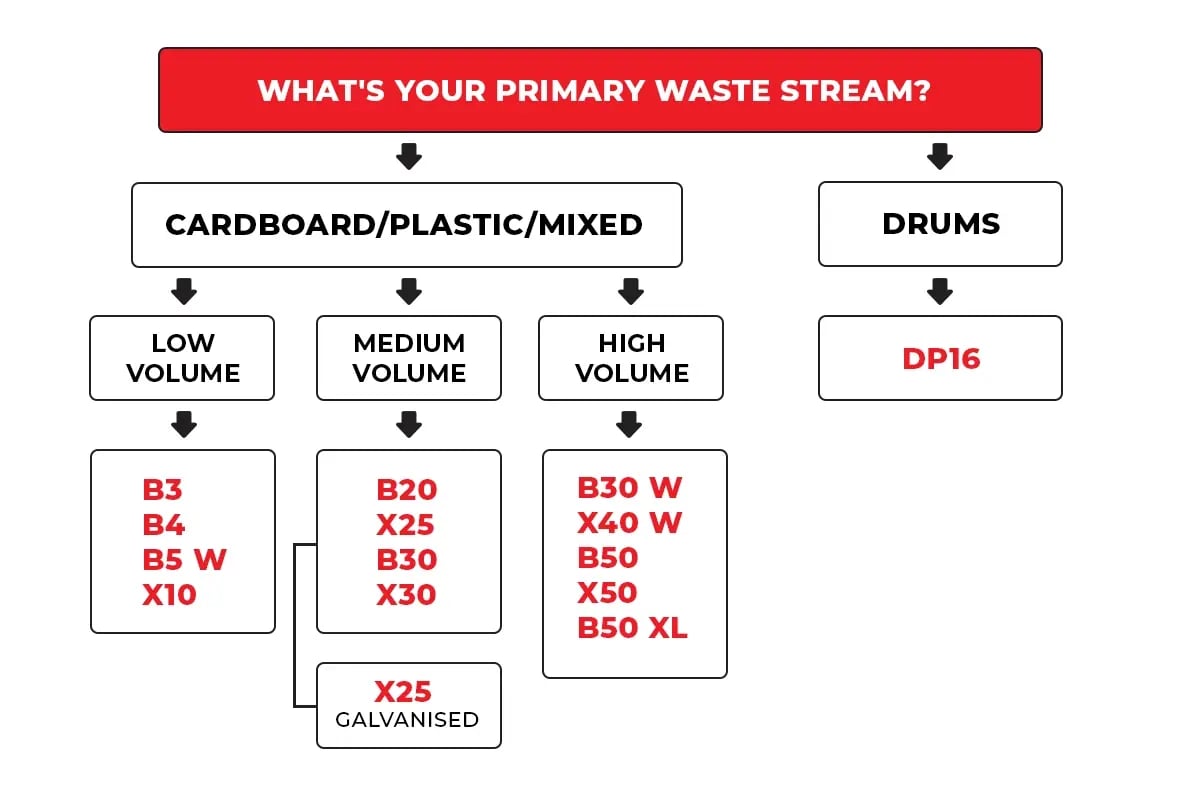
Quick starting point
- Mainly cardboard from a small retail site → start with the B3, B4, or B5W.
- Mixed recyclables such as PET bottles and cans → consider the X-series.
- High-volume manufacturing or logistics → look at the B50 or X50.
- Steel or oil drums → the DP16 Drum Press is purpose-built for that application.
-
Assess your waste volume. Estimate your average daily or weekly waste generation, then use that to gauge required throughput rather than sizing to a single busy day. Add some headroom for seasonal peaks or business growth rather than sizing exactly to current output.
Match your estimate against Wastech's tiers:
- Low volume: B3 or B4
- Medium volume: B20, X25, X30, or B30
- High volume: B50, X50, or B50 XL SD.
The amount of material generated is one of the most important factors when choosing a baler. A machine that is too small may require frequent cycles, while a larger model may provide capacity that is not required for a lower-volume site.
-
Evaluate your available space. Measure floor space, ceiling height, and door access.
Small balers fit in most storerooms, wide-opening models like the B30W need more floor width but suit lower ceilings, and the B50 XL SD's extra-wide door needs sufficient clearance for loading and bale handling.
Noise varies meaningfully by model too, from around 57 dB on the quietest small models up to 71 dB on the largest, so check the specific model's rating for noise-sensitive environments.
-
Consider your material type. Cardboard, paper, and plastic, suit any B-series model. Mixed recyclables such as PET, cans, textile, and EPS suit X-series models. Steel or oil drums need the Drum Press DP16.
-
Determine power requirements. Single-phase 240V covers the B3, B4, B5W, and the single-phase X10 variant.
Three-phase 415V is required for the three-phase X10 variant and all medium, large, and extra-large models.
-
Match automation needs. Every model except the B3 uses automatic bale ejection; the B3's manual ejection suits its very low-volume use case.
For higher-volume sites, consider how often operators will need to load, tie, and remove finished bales. Automatic ejection can reduce manual bale handling without requiring a fully automated system.
-
Budget and ROI considerations. Entry-level models suit low-volume operations with limited capital, while larger models typically reduce collection frequency and associated costs over time.
Total cost of ownership extends beyond the purchase price too. Ongoing consumables like tying wire or twine, plus routine servicing, factor into the real cost over the machine's working life.
NSW businesses may also be eligible for the NSW Bin Trim Rebates Program, which can offset up to 50% of the capital cost, with rebates ranging from $1,000 to $50,000.
When assessing ROI, compare the equipment cost against current collection costs, waste storage requirements, labour involved in handling recyclable materials, and any revenue available from separated recyclable materials.
-
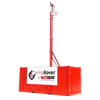
Smart monitoring capabilities. All Bramidan balers supplied by Wastech are compatible with BRA-IN, a real-time monitoring platform that tracks operational status, links unlimited machines with automatic collection alerts, tracks equipment location, and provides remote service support direct from the Bramidan Service Center.
-
Consult with an industry expert. A professional waste audit matches your actual waste stream data to equipment capacity. Wastech's team conducts site assessments across Australia.
A site assessment can also identify practical installation requirements, including available space, power supply, material handling, and collection arrangements.
-
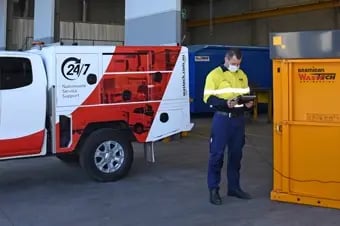
Choose a supplier with comprehensive support. Wastech's after-sales programme covers preventative maintenance, premium spare parts held for quick dispatch, and 24/7 emergency breakdown support, backed by service branches across Hallam VIC, Wetherill Park NSW, Banyo QLD, and Malaga WA.
For a long-term equipment investment, installation, operator training, preventative maintenance, parts availability, and technical support should all be considered when comparing suppliers.
Common Applications by Baler Type
Retail and supermarkets. Small retailers producing low volumes of cardboard and plastic film suit compact back-of-store models (B3, B4), while supermarkets generating multiple bins daily need medium-capacity machines with faster cycle times (B20, B30, X25). Major national retail chains use balers to manage the constant flow of cardboard packaging from deliveries. In a best-case scenario, installing a baler can cut the number of waste collections a retailer needs from around ten down to just one, reducing both collection costs and the extra emissions that come with more frequent pickups.
Distribution centres and logistics. High-volume e-commerce and logistics operations generate large, continuous cardboard streams best handled by large-format or extra-large balers (B50, X50, B50 XL SD).
Manufacturing. Light manufacturing with mixed waste streams suits the X30, while heavy industrial operations with high throughput typically need the B50 or X50.
Hospitality. Hotels, restaurants, and venues generally need compact, quiet balers for back-of-house installation (B4, B5W, X10).
Education. Schools and universities benefit from simple, easy-to-operate models that don't require dedicated waste handling staff (B3, B4, X10).
Specialty applications. Outdoor or wet environments call for the X25 Galv or X50 Galv; bulky boxes or lower ceilings suit the B30W; steel or oil drums require the Drum Press DP16.
Conclusion: Which Type of Baler Machine Is Right for You?
Types of baler machines break down along three practical lines: size (small, medium, large, extra-large, and specialist), material (cardboard, plastic, and aluminium cans), and automation level (manual through to automatic ejection). For most Australian businesses, the right starting point is matching waste volume and available space to one of Wastech's size tiers, then refining the choice by material mix, power supply, and any environmental factors like moisture or ceiling clearance.
Ready to find the right fit? Book a free waste audit and Wastech's team will match your actual waste stream to the right baler type and model.
Next Steps: Selecting Your Baler Type
- Assess your requirements using the selection criteria above.
- Review the full vertical baler range.
- Request a free waste audit to confirm the right model for your site.
- Check your eligibility for the NSW Bin Trim Rebates Program.

AUTHOR
Peter Jessup


Peter Jessup is a Product Specialist at Wastech Engineering, focused on balers, compactors and fire detection and suppression systems. With over 12 years at Wastech, he works with operators across waste and resource recovery, shopping centres, retail, hospitality and distribution centres, delivering efficient, dependable solutions that improve operational performance and support safer, more sustainable waste management.